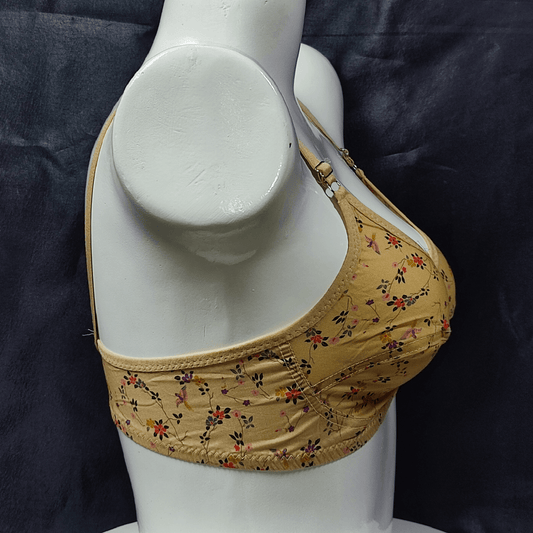
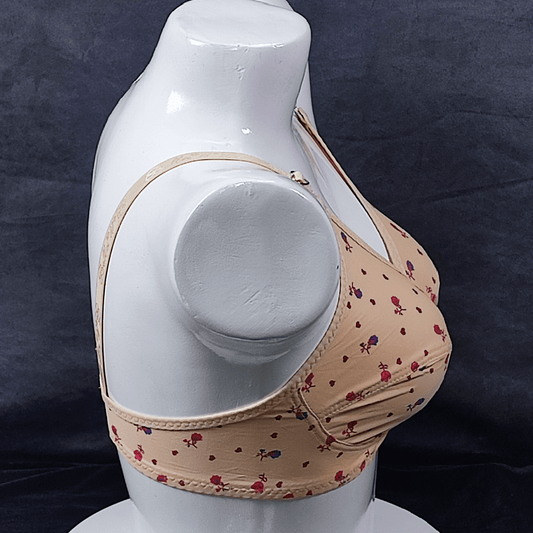
How to use a bra size chart calculator at home: measuring tips for Pakistani women
If you have ever struggled with a bra that digs into your shoulders, gaps at the cups, or rides up your back by midday, you are far from alone, and the problem is almost certainly the size, not your body. A bra size chart calculator takes the two measurements you can take at home and converts them into a band size and cup size in seconds, removing the trial-and-error that makes bra shopping so frustrating. This guide walks you through exactly how to measure correctly, how to use a bra size calculator, and how to read UK, US, and EU labels without getting lost. Pull out a soft measuring tape, and let us get your numbers right.
The two measurements you need (and exactly how to take them)
Measuring your underbust for the band size
The underbust is the circumference of your ribcage directly below your breast tissue, right where the bra band sits. Stand straight with your arms relaxed at your sides. Wrap the soft measuring tape snugly around your ribcage at that point, keeping it level all the way around. Breathe out naturally, then read the number. Do not pull it tight enough to compress your skin, but do not let it sit loose either, snug is the key word. This number, in inches, gives you your band size. If you measure 34 inches, you are a 34 band.
Measuring your overbust for the cup size
The overbust measurement captures the fullest part of your bust, which is usually across the nipple line. Keep the tape parallel to the floor and let it sit snug without pressing in or flattening anything. Skip the padded bra for this step, since extra padding adds volume and pushes your reading higher than your actual size. Write both numbers down. The gap between them is what determines your cup letter, and this is precisely what a cup size calculator uses to assign your fit.
Mistakes that silently change your result
Almost everyone makes at least one of these errors the first time, so this is simply useful to know. Measuring over thick clothing adds bulk to the reading, sometimes by an inch or more, which can push you into a cup size that does not reflect your body at all. Slouching or twisting changes the shape of your torso and distorts both measurements. Placing the tape too high on the ribs, or accidentally dropping it towards the navel instead of directly under the bust, can throw your band calculation off by one or even two sizes. Do it standing in front of a mirror once and you will catch most of these naturally.
How a bra size chart calculator converts your numbers into a size
The formula behind every bra sizing chart
The logic is straightforward. Subtract your underbust from your overbust, and that difference maps to a cup letter. In inches, the scale works like this: a 1-inch difference is an A cup, 2 inches is a B, 3 inches is a C, 4 inches is a D, and 5 inches is a DD or E cup. If you measured in centimetres, each cup step is approximately 2.5 cm. So if your overbust is 96 cm and your underbust is 81 cm, the 15 cm difference, roughly 6 inches, puts you around a DD cup with an 81 cm band, which converts to approximately a 32DD in UK sizing. Bear in mind that different brands construct their bras differently, so treat this as a solid starting point rather than an absolute verdict.
Body shape, breast position, and how a particular brand constructs its bras all affect real-world fit. The formula gives you an accurate place to begin, which is far better than guessing in a fitting room with no reference point at all.
What cup letters actually represent
Here is the part that surprises most women: a D cup is not a fixed breast size. It is a proportion. Specifically, it means your overbust measurement is 4 inches more than your underbust. A 32D and a 38D hold completely different volumes of breast tissue. They share the same cup letter only because the difference between bust and band is identical. This is why two women wearing the same cup letter can look entirely different, and why the idea that a D cup is automatically large is a myth rooted in misunderstanding how the maths actually works.
Using the ComfyBliss bra size chart calculator
Once you have both measurements, head to the ComfyBliss bra size chart calculator on the website. Enter your underbust and overbust in either inches or centimetres, and the tool returns your band size, cup size, and the closest available size from the collection. It is quick and straightforward, acting as the practical bridge between your tape measure and the shopping cart, removing the guesswork that makes online bra shopping feel like a gamble.
Making sense of UK, US, and EU size conversions
Why band numbers look different across sizing systems
UK and US systems both use inch-based band numbers: 32, 34, 36, 38, and so on. EU sizing uses centimetre-based numbers that run approximately 15 higher than their UK equivalents. A UK 34 is an EU 75. A UK 36 is an EU 80. A UK 38 is an EU 85. For Pakistani women shopping from international websites or imported brands, this bra size conversion chart difference is the single most common point of confusion. You see "EU 80" on a label and assume it means a much larger band than your usual 34, when in fact they refer to the same size.
ComfyBliss follows UK sizing, which aligns with the system used by many Pakistani and Indian lingerie brands. If you have bought a bra locally and the label read 34B, you have been working in UK sizing without necessarily realising it.
Where UK, US, and EU cup letters diverge
Cups A through D are consistent across all three systems. After D, the naming splits. UK sizing continues as DD, E, F, FF, G, GG. US sizing labels those same volumes as DD, DDD/F, DDDD/G, H. EU sizing continues as E, F, G. In practical terms: a UK 36E is the same as a US 36DDD/F and an EU 80F. Knowing this matters when a brand you love is imported and the label uses US or EU notation. Always check which system the brand uses before reading the cup letter.
Sister sizes: your backup when the exact size is out of stock
How sister sizes preserve cup volume
Sister sizes are adjacent sizes on the bra size chart that hold approximately the same cup volume by shifting the band and cup in opposite directions. The classic example: 34C, 32D, and 36B are all sister sizes. They contain roughly the same amount of breast tissue. What changes is the band and how it distributes support across the torso. This is why many women try a sister size and find it fits surprisingly well, even though the label looks different from what they usually wear.
When to go up or down and which direction to choose
The decision is straightforward once you know what is not working. If the cups fit but the band feels too tight, go up one band size and down one cup. If the cups fit but the band is too loose, go down one band and up one cup. If the cups themselves are gaping or overflowing, sister sizing alone will not fix it: the cup size itself needs to change.
One caveat worth noting: sister sizes are an approximation. Band tension shifts with size, so the fit is similar but not identical. ComfyBliss offers a 7-day refund policy on eligible unused items, which makes trying two sister sizes a relatively low-risk experiment and takes much of the stress out of the process.
Fit issues by style: everyday bras, sports bras, and wire-free options
Everyday bras and what poor fit looks like
The signs are specific once you know what to look for. Straps digging into your shoulders usually mean the band is too loose and the straps are compensating by carrying more weight than they should. Underwire sitting on breast tissue rather than on the ribcage below it signals a cup that is too small. A band riding up at the back means it is too large. The centre panel not lying flat against your sternum usually means the cup is too small or the shape does not suit your breast position. For T-shirt and full-coverage bras, these issues are even more visible because smooth fabric hides nothing.
Sports bras, wire-free, and front-closure styles
Fit priorities shift depending on the style. Sports bras should hold the bust firmly with minimal movement under impact, and they often run about one size smaller than a regular bra because compression is the point. Wire-free bras rely entirely on a wide, well-fitted band for support, so the band measurement needs to be precise, there is no underwire to share the load. Front-closure bras suit women who find back clasps awkward to reach, and some designs may fit slightly fuller in the cup than a standard underwire, since there is no side-wire contributing to the structure.
ComfyBliss carries options across all three categories. If you are unsure which style suits your measurements and daily routine, the support team is on hand to help before you purchase, not just afterwards.
Putting your new size to work when shopping at ComfyBliss
Choosing the right bra once you have your number
With your accurate band and cup size confirmed, the selection process becomes far more manageable. Everyday T-shirt and full-coverage bras are commonly available across the 32 to 40 band range. Wire-free and front-closure styles are particularly popular among women with larger cups and those who prioritise comfort throughout the day. Sports bras offer real support during exercise without the structure of underwire. The ComfyBliss size chart appears on every product page for easy reference, though it is worth re-measuring if your body has changed since your last purchase.
Why shopping with the right numbers makes online buying far less daunting
Buying intimate apparel online without trying anything on feels risky, and that concern is completely reasonable. With accurate measurements and a reliable bra size chart calculator, much of the uncertainty disappears. Every ComfyBliss order arrives in plain, discreet packaging with no branding that identifies the contents, which matters for privacy-conscious shoppers across Pakistan. Free shipping applies to orders above Rs. 3,000, and the 7-day refund policy covers eligible unused items if something still does not feel right. Getting the size right from the start means fewer returns and a much more satisfying experience overall.
Getting it right from here
Fit problems, digging straps, gaping cups, bands that ride up, are commonly caused by an incorrect band or cup size, or by a mismatch between the bra shape and your breast shape. They are solvable. Take your underbust and overbust, subtract to find the cup difference, cross-reference the bra size conversion chart for whichever system the brand uses, and keep sister sizes in mind when your exact size is not available. Knowing how to measure bra size accurately is a skill that serves you every time you shop.
Bra size is not a fixed number across a lifetime. Weight changes, pregnancy, hormonal shifts, and even posture habits all affect how a bra fits. Use the ComfyBliss bra size chart calculator as your reference each time you shop, especially if anything about your body has changed since you last measured. A few minutes with a tape measure is all it takes to stop guessing and start wearing something that actually fits.
The ComfyBliss collection is there when you are ready, use the size calculator on any product page, and the support team is on hand if any questions come up. Comfortable, well-fitted lingerie is not a luxury. It is simply what a bra is supposed to feel like.
Frequently asked questions about using a bra size chart calculator
How accurate is a bra size chart calculator?
A bra size chart calculator is accurate when your two input measurements, underbust and overbust, are taken correctly. The formula it uses is the same one professional fitters apply. Real-world fit can still vary between brands because of differences in construction, fabric, and cup shape, so treat the calculator result as a reliable starting point and adjust by one size if needed after your first wear.
Should I measure in inches or centimetres?
Either works. The ComfyBliss bra size chart calculator accepts both. If you are more comfortable with centimetres, measure in centimetres, the tool handles the conversion. Just be consistent: use the same unit for both your underbust and overbust measurements.
How often should I re-measure?
Re-measure whenever your body changes, after significant weight fluctuation, pregnancy, or hormonal shifts. As a general habit, checking your measurements once a year is a sensible practice, since bra size can shift gradually without you noticing until the fit starts to feel off.